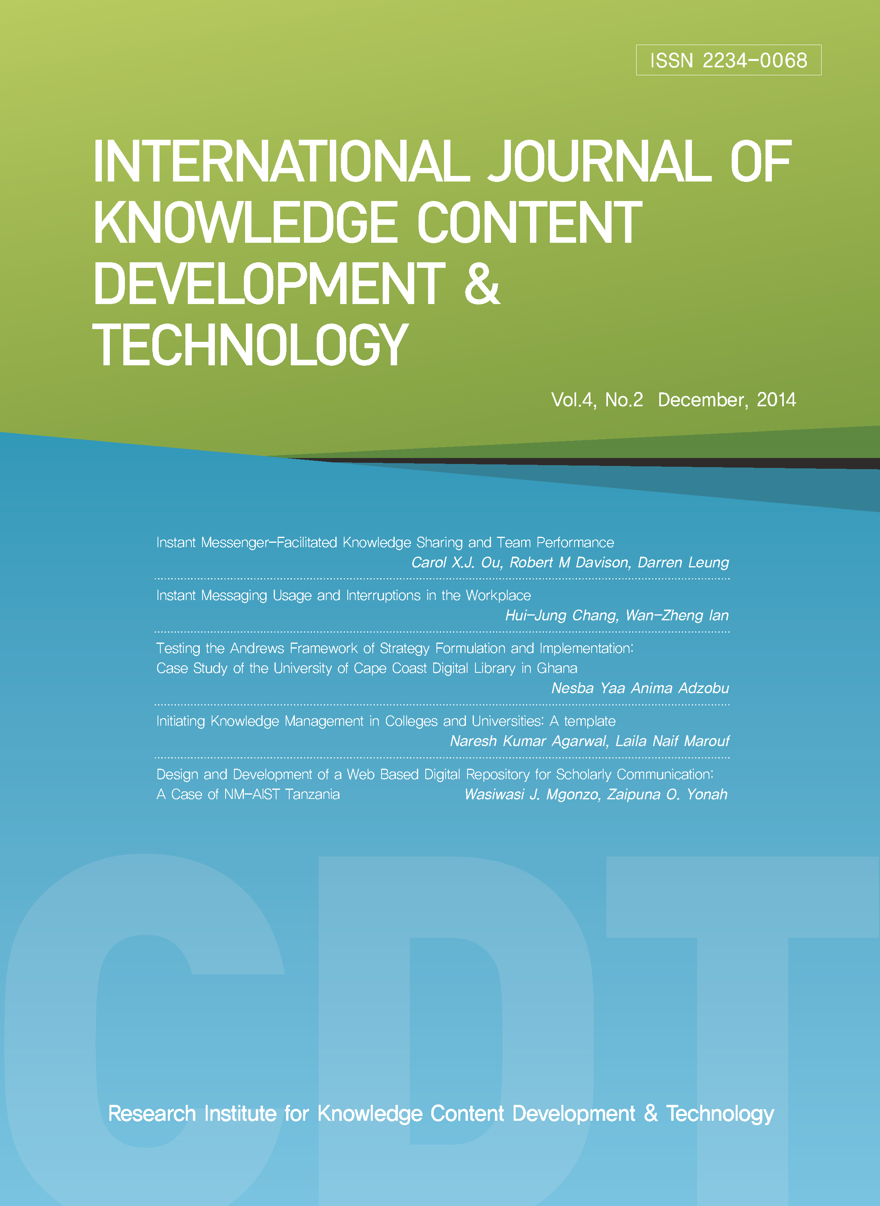
Instant Messaging Usage and Interruptions in the Workplace
Keywords:
Instant Messaging, media usages in the workplace, IM interruptionAbstract
The goal of the present study is to explore IM interruption by relating it to media choices and purposes of IM use in the workplace. Two major media choice concepts were: media richness and social influence; while four purposes of IM use were: organization work, knowledge work, socializing, and boundary spanning activities. Data (N = 283) were collected via a combination of convenience and snowball sampling of “computer‐using workers” in Taiwan, based on the Standard Occupational Classification system published by the Taiwan government. Results indicated that media choice works better than purpose of IM use to explain IM interruption. Among them, social influence was the best predictor to IM interruption in the workplace. In addition, instant feedback and personalization provided by IM, and IM usage for the purposes of knowledge work and socializing, also relate to IM interruption in the workplace.
Publication Facts
Reviewer profiles N/A
Author statements
Indexed in
- Editor & editorial board
- profiles
- Society
- N/A
- Publisher
- RIKCDT(Research Institute for Knowledge Content Development & Technology)

To learn about these publication facts, click 
PF is maintained by the Public Knowledge Project
Downloads
Published
How to Cite
Issue
Section
License
Copyright (c) 2014 International Journal of Knowledge Content Development & Technology

This work is licensed under a Creative Commons Attribution-NonCommercial-NoDerivatives 4.0 International License.
- The authors retain copyright in their work.
-
The RIKCDT is granted a non-exclusive, perpetual worldwide license to publish, disseminate, and maintain the version of record in all media formats, including print and electronic formats.
-
The article will be published under a Creative Commons Attribution-NonCommercial-NoDerivatives (CC BY-NC-ND 4.0) license, which permits users to read, download, and share the work for non-commercial purposes with appropriate attribution, but does not permit any modification, adaptation, or creation of derivative works.
-
IJKCDT articles may not be republished in whole or in part, whether for commercial purposes, in print or online.
- No dispute shall be raised on matters RIKCDT already managed on research papers published in previous journal.