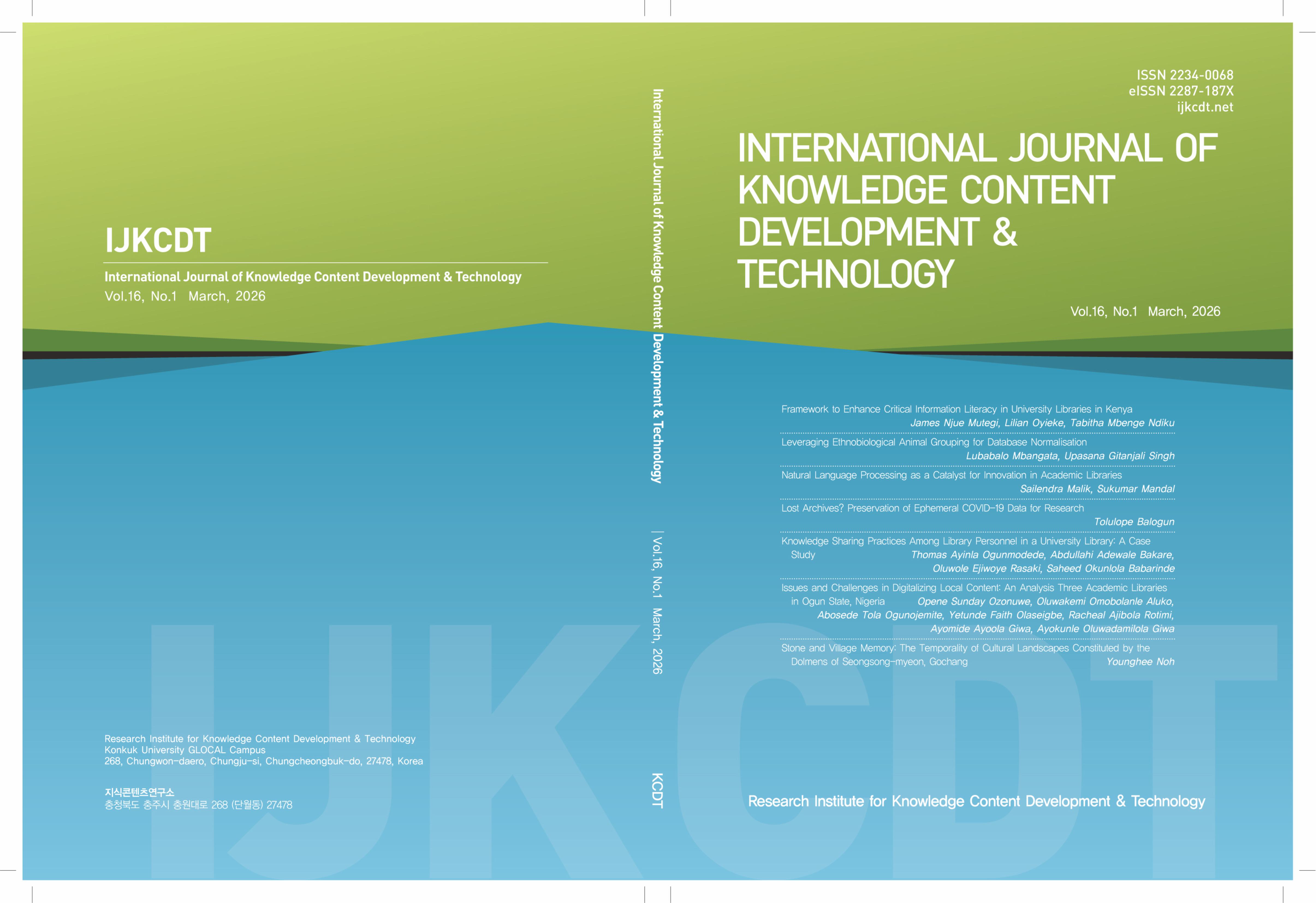
Framework to Enhance Critical Information Literacy in University Libraries in Kenya
DOI:
https://doi.org/10.5865/IJKCT.2026.16.1.007Keywords:
Access, Critical Information Literacy, CIL frameworks, Critical Librarianship, Metaliteracy, Librarian power, University Library, University LibrarianAbstract
Purpose: This study investigated adopting a framework to enhance CIL in selected university universities in Kenya. CIL evaluates the effectiveness of Information Literacy (IL), disrupts unfair systems, and creates student- driven IL instruction.
Methodology: A Descriptive survey research design was used to gather information on a framework to enhance CIL in selected university universities in Kenya. The research was carried out in fourteen university libraries in Kenya. The fourteen university libraries were purposely sampled because they had subscribed to electronic resources and KENET ICT infrastructure and had employed ICT and reference librarians. The target population was 14 University Librarians. The census approach involved all fourteen librarians in this research study. Data was collected on the interview schedule. Atlas. ti was used to analyze qualitative data.
Findings: These findings show that university librarians associate CIL with information retrieval. In addition, the findings revealed that the librarians identified key codes of CIL, such as supporting users in access to information, user education, critical thinking, and user information resources. Based on these findings, the study proposes a CIL framework consisting of six steps: Awareness Creation, User needs Assessment and Information Gap, CIL Library Infrastructure, CIL infrastructure, Librarian Empowerment, User Empowerment, and CIL Evaluation.
Publication Facts
Reviewer profiles N/A
Author statements
Indexed in
- Editor & editorial board
- profiles
- Society
- N/A
- Publisher
- RIKCDT(Research Institute for Knowledge Content Development & Technology)

To learn about these publication facts, click 
PF is maintained by the Public Knowledge Project
Downloads
Published
How to Cite
Issue
Section
License
Copyright (c) 2025 James Njue Mutegi, Lilian Oyieke, Mbenge T. Nduku

This work is licensed under a Creative Commons Attribution-NonCommercial-NoDerivatives 4.0 International License.
- The authors retain copyright in their work.
-
The RIKCDT is granted a non-exclusive, perpetual worldwide license to publish, disseminate, and maintain the version of record in all media formats, including print and electronic formats.
-
The article will be published under a Creative Commons Attribution-NonCommercial-NoDerivatives (CC BY-NC-ND 4.0) license, which permits users to read, download, and share the work for non-commercial purposes with appropriate attribution, but does not permit any modification, adaptation, or creation of derivative works.
-
IJKCDT articles may not be republished in whole or in part, whether for commercial purposes, in print or online.
- No dispute shall be raised on matters RIKCDT already managed on research papers published in previous journal.